Explore Hin Raab South – Koh Chang's Stunning Reef Dive
Colorful corals, reef walls, and vibrant marine life await you at Hin
Raab South – a perfect site for beginners and experienced divers.
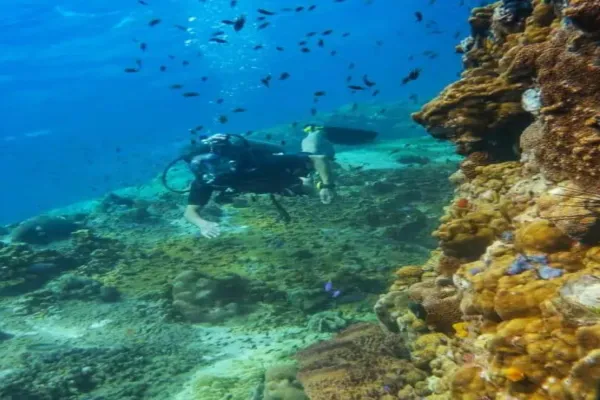
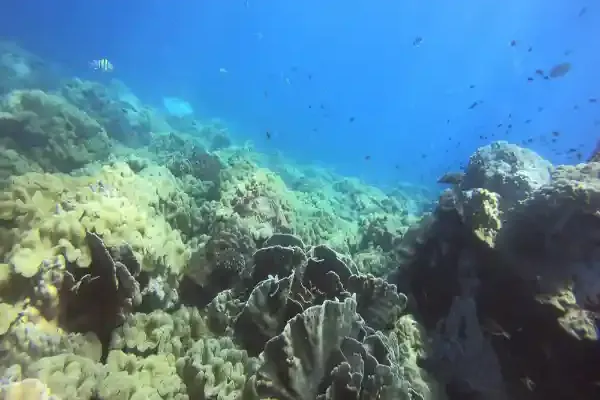
Colorful reef walls and vibrant marine life at Hin Raab South
Picture swimming along a colorful reef wall where
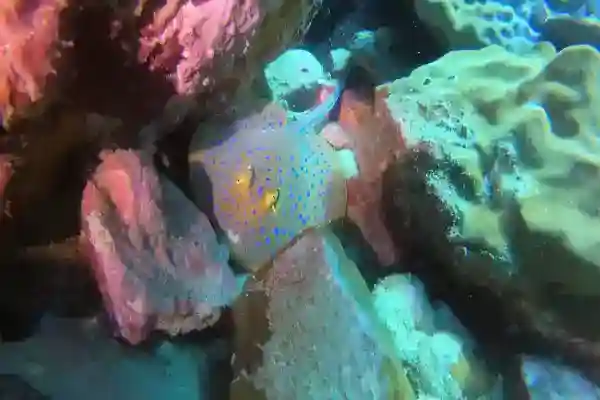
green sea turtles glide past, blue-spotted stingrays rest on the sand,
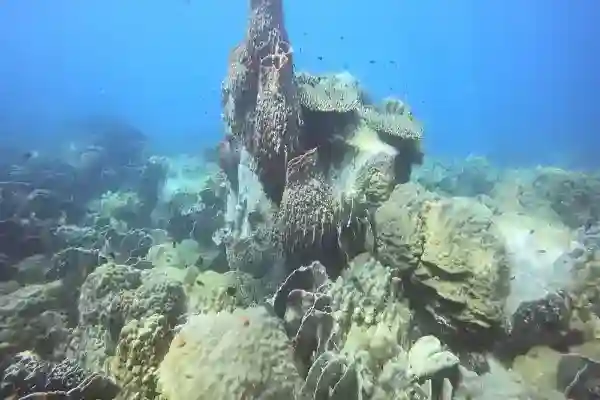
and moray eels peer from crevices filled with barrel sponges and
anemones. Welcome to Hin Raab South – one of Koh
Chang's most iconic reef dive sites, located southwest of Bang Bao.
This site features a large flat rock formation with two buoy lines
that lead directly to the reef – no long surface swims required. The
first buoy reaches 6–7 meters, the second a sandy area at 4–5 meters.
What makes Hin Raab South special is its versatility.
At 18 meters maximum depth and shallow areas of 4–7
meters, it's perfect for Open Water divers, try dives, and snorkelers.
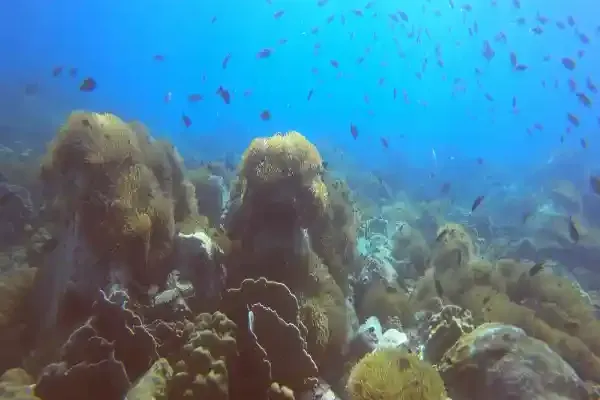
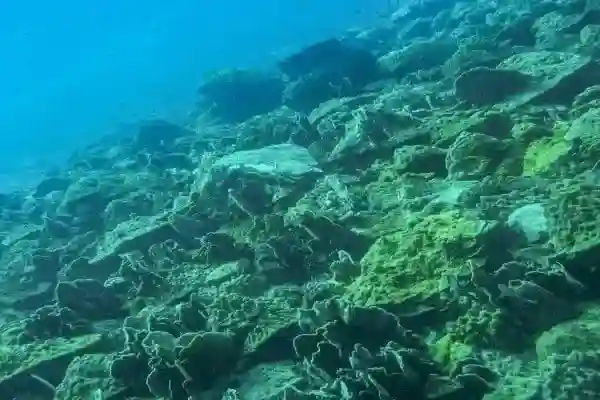
The reef features gentle sloping walls covered with
hard corals, yellow soft corals, whip corals, and purple stag-horn
corals. The site is connected to Secret Reef, forming one large
ecosystem – together they offer about 2 hours of bottom time for full
exploration. Hin Raab South is known for excellent marine life
diversity and is one of the better sites for
green sea turtle encounters, especially during high
season (November–May).
As you explore the reef wall, keep your eyes open for
scorpionfish camouflaged among the corals,
triggerfish and
barracudas patrolling the edges,
trumpetfish hovering vertically, and
fusiliers in schools. The combination of structure,
depth variation, and abundant marine life makes Hin Raab South perfect
for photographers and divers of all experience levels. Whether you're
on your first dive or your hundredth, this reef delivers a memorable
underwater adventure.
Why Dive at Hin Raab South?
Vibrant Coral Reef: Discover a colorful reef filled
with hard corals, yellow soft corals, whip corals, and purple
stag-horn corals.
Exciting Marine Life: Spot moray eels, blue-spotted
rays, triggerfish, barracudas, trumpetfish, and even the occasional
turtle.
Beautiful Reef Wall: Swim along the reef wall and
explore hidden crevices filled with scorpionfish, anemones, barrel
sponges, and more.
Dive Briefing Example for Dive Professionals – Hin Raab South
This is a comprehensive dive briefing template/example for dive
professionals. Use this as a reference guide to structure your own
briefings. Customize the placeholders (marked with square brackets)
with your specific information, guide names, and current conditions.
This ensures a safe, organized, and professional dive briefing
experience.
1. Dive Site Name & Introduction
Hello everyone and welcome to Hin Raab South! Hin
Raab South is one of Koh Chang's most iconic reef dive sites – a
colorful reef with walls at 18 meters maximum depth,
located southwest of Bang Bao. It's perfect for Open Water divers, try
dives, and snorkelers. The site has two buoy lines leading directly to
the reef – no long surface swims. The reef features gentle sloping
walls, coral gardens, and is connected to Secret Reef. It's one of the
better sites for green sea turtle encounters.
My name is [Your Name] and I will be your dive guide today. Hin Raab
South is often combined with Secret Reef for a two-dive day – together
they offer about 2 hours of bottom time.
2. Site Description & Dive Route
We have good conditions today at Hin Raab South. The site has two buoy
lines – the first leads to 6–7 meters, the second to a sandy area at
4–5 meters.
Maximum Depth: 18 meters (reef wall)
Shallow Depth: 4–7 meters (sandy area and plateau)
Dive Route: We'll descend along the
buoy line to the reef. From there, we'll follow the
reef wall, exploring the coral gardens and crevices. The reef has
gentle slopes – we can drift with minimal current or explore at our
pace. Return to the buoy line for our safety stop.
Site Features: Large flat rock formation, two buoy
lines, reef walls with hard corals, whip corals, purple stag-horn,
connected to Secret Reef.
Weather Conditions: [Current conditions - e.g.
"Clear water, good visibility, minimal current"]
What You Can See at Hin Raab South
Hin Raab South is known for excellent marine life. During your dive,
look for:
Green sea turtles – especially during high season
(November–May)
Blue-spotted stingrays – often resting on the sandy
bottom
Moray eels – peering from crevices and barrel
sponges
Triggerfish, barracudas, trumpetfish, fusiliers –
patrolling the reef
Scorpionfish – camouflaged among the corals
For a complete guide to marine life in Koh Chang, check our
Marine Life Guide.
3. Your Guide's Role & Positioning
I will be leading this dive and wearing
[Color] and [Color] fins with a
[Description of equipment/identifying feature]. You
can easily identify me by [specific visual identifier - e.g. "my
bright yellow BCD with the Chang Diving logo"].
[If applicable] Our Divemaster [Name] will be positioned at the back
of the group, keeping an eye on everyone. [Name] will be wearing
[Color] fins and will use [signal device - e.g. "this
tank banger"] to get your attention if needed.
Important: Stay close to the group and maintain
visual contact with your buddy and guide at all times. If you need to
communicate, use standard hand signals or get my attention by tapping
on your tank.
4. Entry & Exit Techniques
Boat Entry (Giant Stride)
We'll enter the water from the side of the dive boat with a
Giant Stride. Here's what you should remember:
Pre-Dive Safety Check: Complete your BIG WHALES
REALLY ARE FUN check before entering the water
BCD Inflation: Fully inflate your BCD before entry
Regulator: Keep your regulator in your mouth
Mask: Make sure your mask is properly fitted
Entry: Step forward with one leg, then the other,
keeping legs together
After Entry: Clear the area immediately, signal OK,
and swim to the buoy line
Boat Exit (Ladder)
After completing your safety stop and surfacing:
Swim back to the ladder on the side of the boat
Stand on the ladder and remove your fins (hand them to the crew)
Climb up the ladder with your regulator still in your mouth
CRITICAL: Never position yourself directly under
another diver climbing the ladder
Once on deck, move away from the entry/exit area
Dinghy Entry (Backroll)
If we're using a dinghy, we'll enter with a
backroll entry:
Sit on the edge of the dinghy with your back to the water
Complete your pre-dive safety check
Hold your mask and regulator in place
On three, lean back and roll into the water
Clear the area and signal OK
5. Dive Procedures & Turn-Around Points
To ensure we have enough air for a safe return and safety stop:
Turn-Around Point: We'll turn the dive around when
you reach 130 bar (or 1900 PSI). This gives us more
than enough air reserve to safely return to the buoy line and
complete our safety stop.
Air Monitoring: Check your air gauge frequently
throughout the dive. Don't wait until you're low on air to signal –
communicate early!
Safety Stop: At 5 meters depth, we'll conduct a
3-minute safety stop at the buoy line before
surfacing.
Emergency Oxygen: Located in the transport box on
the right of the captain's seat in the captain's cabin
First Aid Kit: Located in the transport box on the
right of the captain's seat in the captain's cabin
Emergency Action Plan: For detailed emergency
procedures, see our
Emergency Plan Guide
7. Hand Signal Review
Hand signals can vary between countries and certification agencies, so
let's make sure we're all on the same page. Here are the essential
signals we'll be using today:
OK: [Description/visual] - Used to ask "Are you
OK?" and respond "I'm OK"
Problem: [Description/visual] - Hand waved side to
side to indicate a problem
Up: [Description/visual] - Thumbs up means "I want
to go up"
Down: [Description/visual] - Thumbs down means "I
want to go down"
Air Pressure: [Description/visual] - Show numbers
with fingers (e.g. "I have 120 bar")
Low on Air: [Description/visual] - Hand across
throat
Out of Air: [Description/visual] - Hand across
throat, then point to regulator
Safety Stop: [Description/visual] - Hand
horizontal, palm down, at 5 meters
Stop/Hold: [Description/visual] - Hand up, palm
forward
Look/Point: [Description/visual] - Point at
something interesting
Practice Question: Can you show me how you would
communicate that you still have 120 bar of air pressure?
Green sea turtles: Protected species – observe
from a distance, never touch or chase
Triggerfish: Can be territorial during nesting
season – maintain respectful distance
Fire coral: Can cause skin irritation – avoid
contact
Buoyancy Control: Maintain excellent buoyancy to
avoid damaging corals or stirring up sediment
Conservation: Take only photos, leave only bubbles.
Never remove anything from the reef
10. Pre-Dive Safety Check
Before every dive, we use the acronym
"BIG WHALES REALLY ARE FUN" to make sure nothing is
forgotten. For a detailed guide on why safety checks are important and
how to do them correctly, check out our
Safety Check Guide:
B - BCD: Check that your BCD
inflates and deflates correctly. Test the power inflator and dump
valves.
I - Inflation: Make sure your BCD
fits properly and all straps are secure.
G - Gauges: Check your SPG
(submersible pressure gauge), depth gauge, and computer. Make sure
they're working and readable.
W - Weights: Check that your
weight belt or integrated weights are secure and properly
positioned.
H - Hose: Check all hoses for
kinks or damage. Make sure your regulator hoses are routed
correctly.
A - Air: Turn on your air, check
your tank pressure, and take 2-3 breaths from your regulator.
L - Releases: Test all quick
releases on your BCD, weight system, and any other equipment.
E - Everything: Check once more
that everything is in place and working.
S - Snaps: Make sure all buckles
and fasteners are secure.
R - Releases: (Second check)
Verify that all releases are functioning.
E - Everything: Final check – is
everything ready?
A - Air: Final air check –
regulator working, tank pressure good.
L - Look: Look around – is your
buddy ready? Is the entry area clear?
L - Listen: Listen for final
instructions from your guide.
Y - You: Are YOU ready? Take a
deep breath, relax, and enjoy the dive!
A - Again: One more quick check –
everything safe?
R - Ready: Are you ready to dive?
E - Everything: Final everything
check.
F - Fun: Remember – diving is FUN!
Relax and enjoy!
U - Underwater: Ready to go
underwater?
N - Now: Let's dive NOW!
Pro Tip: Do this check with your buddy. It's a great
way to catch problems before entering the water and helps build
confidence.
📋 Quick Briefing Checklist
✅ Site name and conditions understood
✅ Dive route and depths clear
✅ Guide identification confirmed
✅ Entry/exit procedures reviewed
✅ Turn-around points and air reserves understood
✅ Emergency procedures clear
✅ Hand signals reviewed
✅ Buddy paired and checked
✅ Environmental awareness discussed
✅ Pre-dive safety check completed
Questions? If you have any questions or concerns,
please ask now - I'm here to help! Remember, there are no stupid
questions when it comes to dive safety. Let's have a safe and amazing
dive! 🌊🤿
📝 After Your Dive: Log Your Experience
Don't forget to log your dive! Your dive logbook is an important
record of your diving experience and is required for many advanced
courses. Whether you use a digital app or a traditional logbook,
make sure to record:
For more information on why dive logbooks are important and what to
include, check out our
Dive Logbook Guide. You can find the dive site stamp and get your logbook signed by
your guide at the coffee station on the boat.
What Divers Say About Chang Diving
Join hundreds of happy divers who've explored the underwater
world of Koh Chang with us. From first-time try dives to deep
wreck adventures – discover why Chang Diving is trusted since
2005.
★★★★★
Chang Diving Center
★★★★★4.8from 400+ guest reviews
AI overview
Chang Diving Center offers a remarkable diving experience with
exceptional instructors like Andy and Pern, who ensure a safe
and enjoyable journey. Guests appreciate the knowledgeable
team, excellent training, and a welcoming atmosphere. The
center's well-organized trips and attention to detail, along
with thoughtfully prepared onboard amenities, make it a
standout choice for divers of all levels.
“Just finished my Deep Diver and Wreck Specialty courses here
with Instructor Pern – absolutely amazing experience from
start to finish. Safety was always the priority, but every
dive was also genuinely fun. Can't recommend Chang Diving and
Instructor Pern enough.”
“I completed my Open Water course at Chang Diving Center and
everything was perfectly organized. Great service, a very
friendly and professional team, and an excellent instructor.
My instructor Pern was extremely skilled, calm, and in full
control at all times. Highly recommended – 10/10.”
“This was my first sea dive after having qualified and the
staff at Chang Diving were superb and professional ensuring my
experience was the best – in fact I booked a second dive with
them.”