
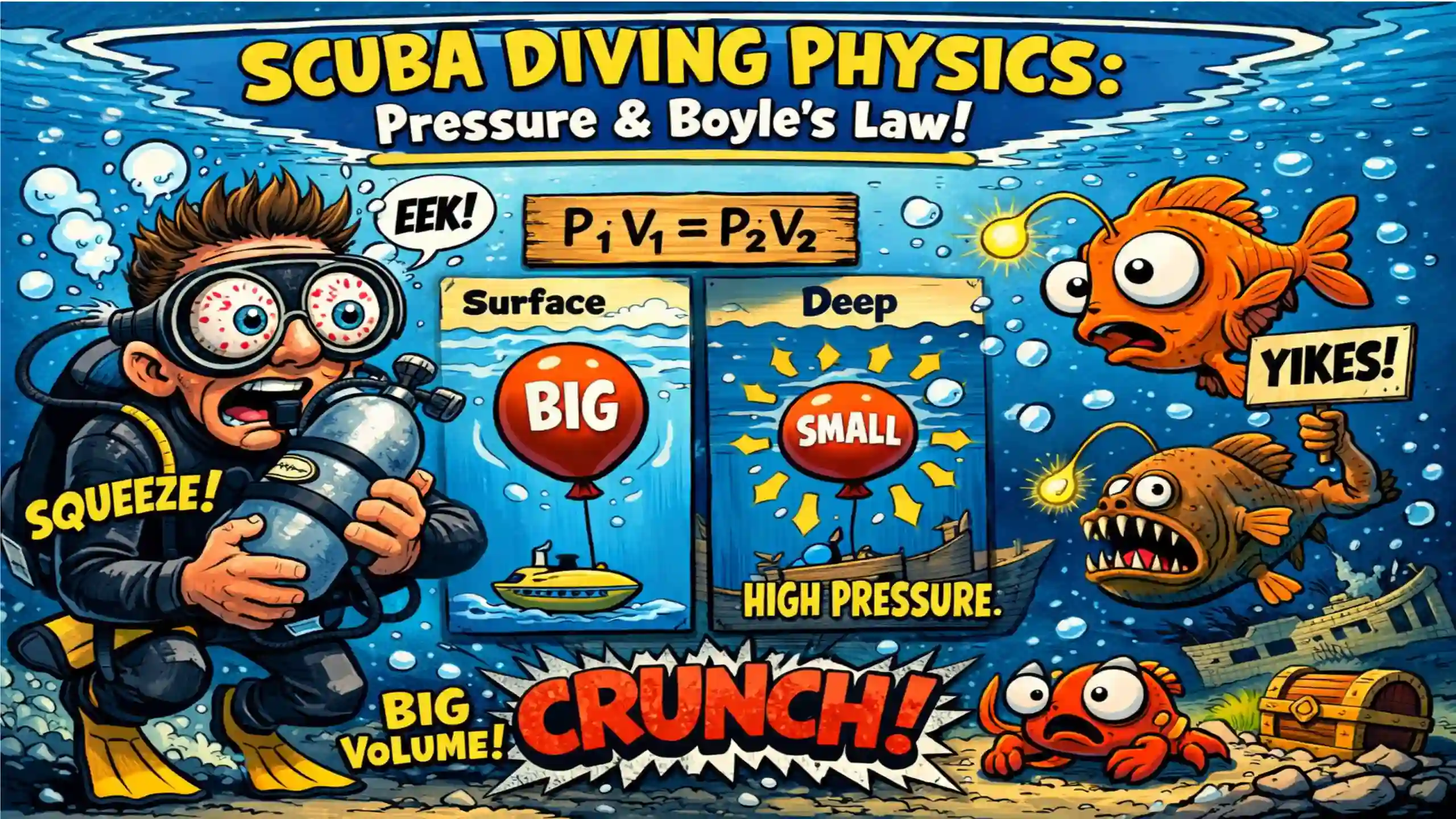
🧠 Scuba Diving Physics – Pressure & Boyle’s Law (Real Examples)
Most divers learn skills first — but fewer pause to picture what the water is actually doing to the gas they carry and breathe. Yet every metre up or down, and every breath, follows simple physics. When you grasp pressure and Boyle’s Law, buoyancy, gas use and ascents start to make sense instead of feeling like luck.
That understanding usually improves:
- Buoyancy and small, precise BCD adjustments
- Air consumption (and calmer breathing)
- Controlled, predictable ascents
- Overall confidence underwater
This article stays practical — part of our Scuba Knowledge series: short theory, then patterns you recognise on Koh Chang dive sites — from shallow reefs to the HTMS Chang wreck. For numbers and SAC planning, pair it with our gas consumption guide.
Training note: This is educational background, not a substitute for your agency materials, instructor or dive computer.
🌊 Pressure in diving — the foundation
Ambient (surrounding) pressure is the physical backdrop for everything: how dense your breathing gas is, how stiff your drysuit feels, and how “twitchy” your BCD can get when you are deep.
Rule you learned in Open Water
A standard sea-water classroom approximation: ambient pressure increases by about 1 bar (atmosphere) every 10 m, on top of the 1 bar at the surface.
| Depth (sea water, typical teaching model) | Approx. absolute pressure |
|---|---|
| 0 m | 1 bar |
| 10 m | 2 bar |
| 20 m | 3 bar |
| 30 m | 4 bar |
Fresh water is slightly less dense: for precision work people sometimes use about 10.3 m per 1 bar — your course and computer handle the details; the idea is the same: deeper equals higher pressure.
Quick calculator: depth → ambient pressure
Uses the same simple classroom models as the table above:
absolute pressure ≈ 1 bar + (depth ÷ m per bar).
Your agency materials and dive computer may use slightly
different assumptions.
What that means on real dives
At about 30 m (≈ 4 bar), each normal lung-full of gas contains roughly four times the amount of gas per breath compared to the surface — if your tidal volume stays similar. Your tank gauge falls faster mainly because of that, not because the regulator “eats” more air by itself.
In practice, workload, cold, stress and poor trim also increase consumption; the pressure effect is the big baseline.
- Same breathing rhythm → much higher gas use per minute at depth
- BCD air is compressed → you often need more inflation deeper
- Small depth changes deep have a smaller relative pressure swing
That is why deep dives feel “different”: the same valve tap moves you less in the water column, and neutral buoyancy needs finer control.
💨 Boyle’s Law — the big idea
For a fixed amount of gas at roughly constant temperature, Boyle’s Law links pressure and volume:
P × V ≈ constant
In plain language: squeeze gas (higher pressure) → smaller volume. Release pressure → volume grows.
Your BCD bladder, exposed cuff, small bubble under a harness, and lungs all follow this pattern on ascent and descent.
📊 Example: fixed amount of air in the BCD
Imagine about 6 litres of air in your wing at 20 m (ambient pressure ≈ 3 bar absolute). If you closed the system and only changed depth — a thought experiment — that same amount of gas would occupy about:
- 20 m (3 bar) → 6 L
- 10 m (2 bar) → 9 L
- Surface (1 bar) → 18 L
Try it: fixed gas in the BCD (Boyle’s Law)
Uses P₁V₁ ≈ P₂V₂ with absolute pressure from the same simple model as the table above (1 bar at the surface + 1 bar per 10 m or 10.3 m). Thought experiment only — a real wing is vented; temperature changes are ignored.
On a real dive you vent and adjust, but the trend is what matters: expansion on the way up is why ascents can run away if you are not venting ahead of the expansion.
⚠️ Runaway ascent (feedback loop)
A common failure mode looks like this:
- You rise a little → pressure drops.
- Gas in the BCD expands → you become more positive.
- You rise faster → pressure drops faster.
- Expansion accelerates unless you vent in time.
Good training and a safety stop mindset break that loop: small early corrections, especially in the last metres.
🔥 The last few metres matter most (relatively)
Between 10 m and the surface, absolute pressure falls from about 2 bar to 1 bar — a halving of ambient pressure. A pocket of gas that was closed off could theoretically double in volume over that band, which is why the shallowest part of the ascent is where buoyancy changes bite hardest.
That is one reason we care about:
- Slow ascent rate and computer guidance
- A calm 3-minute stop near 5 m on many dives — see our safety stop guide
- Releasing gas from the BCD before you float up
🫁 Boyle’s Law and your lungs
Your lungs are not “locked balloons”, but if you hold your breath on open-circuit scuba and ascend, trapped gas expands as pressure falls. That is a core reason for the rule: continuous breathing, no breath-holding on ascent — a core idea in Open Water Diver and follow-on courses.
Snorkelling surface technique is different from breathing compressed gas under pressure — stay inside what your certification covers.
⚙️ Put it to use on the next dive
When pressure and Boyle’s Law click, you tend to:
- Predict buoyancy shifts instead of chasing them
- Vent early and often on the way up
- Stay relaxed, reducing unnecessary gas waste
- Trust your slow ascent and shallow stop protocol
If you want the full beginner-friendly tour of pressure, ears and kit, our theory review page mirrors what we use in the shop before many first dives.
❓ FAQ
Is Boyle’s Law the only physics I need?
It is one pillar. Diving also involves Dalton’s and Henry’s ideas (gas mixes and dissolved gas in tissues) — that is what NDL tables and dive computers summarise for you. Read the companion piece on Dalton & Henry for divers.
Why does my BCD feel “one-shot sensitive” near the surface?
The same valve movement changes volume more relative to the surroundings when pressure is low — small volumes change net buoyancy quickly. Finer bursts of air and good trim help.
Does nitrox change Boyle’s Law?
The pressure–volume behaviour of the gas in your BCD is the same idea. Nitrox changes oxygen exposure limits (partial pressures), not the fact that volume grows as you go shallower. Read Nitrox basics.