

Theory for Beginners / Review for Certified Divers
Theory for Beginners / Review for Certified Divers
Complete Briefing for Try Dive, Scuba Review & Open Water Diver
This quick briefing explains how pressure affects you underwater, how to equalize comfortably, and the key skills you will practice during a beginner experience or refresher course. Whether you're preparing for a Try Dive, need a Scuba Review refresher, or are starting your Open Water Diver course, this theory review covers all the essential knowledge you need.
For Enriched Air (Nitrox) basics, benefits, and MOD planning, see our Nitrox explained guide.
For no-decompression limits (NDL), dive tables vs. computers, and recreational bottom time, see our NDL explained guide.
1) Pressure & Your Air Spaces
How water pressure works
- Water has weight and exerts pressure.
- The deeper you go, the more pressure water exerts.
- Pressure has no effect on water, but it does affect gases (air).
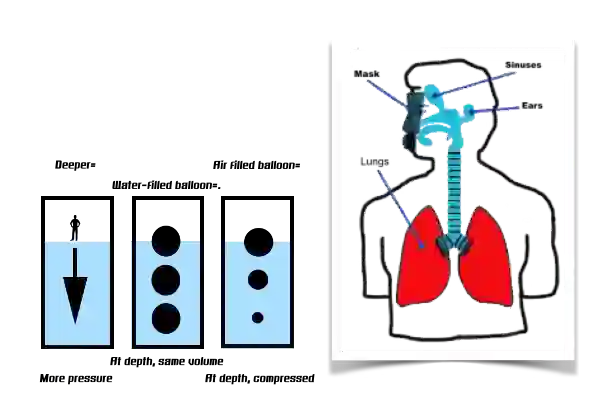
- A water-filled balloon keeps the same volume as you go deeper.
- An air-filled balloon gets smaller (compresses) at depth.
Your body and pressure
Your body is mostly water, so most of you is not affected by pressure changes. However, you have air spaces that are affected by depth:
| Depth | Water-filled balloon | Air-filled balloon |
|---|---|---|
| Deeper = more pressure | Same volume | Compressed (smaller) |
Equalize your air spaces
Increasing pressure compresses unequalized body air spaces. An unequalized air space is uncomfortable and could lead to injury. When you go down (descend), you add air to these spaces to equalize them. You can do this easily because you carry your air supply with you.
Ears & sinuses (during descent)
- Blow gently against pinched nostrils.
- Equalize every metre / few feet while descending.
- Your ears and sinuses must not be congested.
- Equalize before you feel discomfort.
- Do not dive with a cold or congestion.
If you feel discomfort at any time: STOP
- Signal your Instructor.
- Point to your ear (or the area that is uncomfortable).
- Go up a metre / few feet.
- Attempt to gently equalize again.
Mask equalization (during descent)
- Gently exhale air into your mask through your nose as you go down.
Breathing rule (most important)
Your lungs are your most important air space to equalize while going up and down in the water: breathe continuously — never hold your breath.
- Holding your breath traps air in your lungs.
- Trapped air expands as you go up.
- Not breathing normally can cause lung over-expansion (rupture) and may result in serious injury or death.
- This is easy to avoid: inhale and exhale continuously, never hold your breath.
- Take it slow, especially while going up.
As you go up, you do not need to do anything to "release" air in your ears, sinuses and mask — expanding air escapes naturally.
2) Using Your BCD (Buoyancy Control Device)
To float at the surface
- Push the BCD inflator button to add air.
To go down
- Raise the inflator hose and push the deflator button to let air out.
- Descend only when asked to do so by your Instructor / Dive Professional.
Underwater
- Your Instructor / Dive Professional will assist and adjust your buoyancy during the experience.
3) Beginner Skills You Will Practice
A) Clearing water from your regulator
- Remove your regulator and hold on to it.
- Blow small bubbles (you can't inhale, so exhale gently so you don't hold your breath).
- Replace the regulator in your mouth.
- Place your tongue against the mouthpiece.
- Exhale or gently press the purge button to clear the water.
- Resume breathing cautiously.
B) Recovering your regulator underwater (sweep method)
- Remove your regulator and let it fall to your side.
- Continuously blow small bubbles.
- Lean slightly to your right.
- Reach back alongside your cylinder with your right arm.
- Sweep outward with your arm.
- Find the hose on your arm and then locate the mouthpiece.
- Put the regulator into your mouth.
- Exhale or gently press the purge button before inhaling.
- Always breathe cautiously after clearing your regulator.
You can also use this method to recover your regulator at the surface.
C) Clearing water from your mask
- Gently leak a little water in by breaking the seal.
- Let water fill to just below eye level.
- Hold the top of your mask against your face.
- Tilt your head back slightly.
- Exhale through your nose until the water is gone.
- If needed, take another breath through your mouth and repeat the exhale through your nose.
- Resume normal breathing.
D) Using your fins for swimming
- Keep your arms relaxed at your sides.
- Point your toes and keep your body straight.
- Kick slowly from your hips with knees slightly bent.
- Move slowly and glide between kicks.
- Stay close to your Instructor.
E) Monitoring your air gauge (SPG)
- Your air gauge (submersible pressure gauge / SPG) is usually on your left side.
- Check it often (and whenever your Instructor asks).
- Inform your Instructor when your air supply nears the caution zone (time to end the dive).
When it's time to go up
- Your Instructor will give the signal to ascend.
- Stay close to your Instructor.
- Breathe normally and continuously — never hold your breath.
- Ascend no faster than your Instructor.
- Look up and reach up.
- Your Instructor will manage buoyancy with the BCD.
- At the surface: inflate your BCD, relax, and listen to your Instructor.
4) Safety & Emergency Basics
Certified Diver Independence
- As a certified Open Water Diver, you can dive with a buddy (another certified diver) without a Divemaster or Instructor.
- Maximum depth: 18 metres (60 feet) for Open Water Divers.
- Maximum recreational diving depth: 40 metres (130 feet).
- Deeper diving requires Advanced training or specialty courses like Deep Diver.
Buddy System & Separation
- You and your buddy are responsible for conducting your own pre-dive safety check (BWRAF).
- Always stay close to your buddy during the dive.
- If separated: search together for about 1 minute, then reunite at the surface if not found.
Out-of-Air Emergency
- If your buddy signals out-of-air, immediately provide your alternate air source (octopus).
- Establish contact, stay calm, and ascend together in a controlled manner.
Physical Challenges
- Breathing hard: Stop, rest, hold on to something stable. Slow your breathing before continuing.
- Uncontrollable shivering (hypothermia): End the dive immediately. Exit water, dry off, seek warmth.
- Never dive with a cold or congestion: This can cause difficulty equalizing and ear/sinus injuries.
Equipment Failure
- If your dive computer fails: ascend immediately, make a safety stop at 5m for 3+ minutes, surface safely.
Safety Stops
- Safety stops (3 minutes at 5 metres/15 feet) are recommended but not mandatory.
- They significantly reduce decompression sickness (DCS) risk.
Decompression Sickness (DCS) Prevention
- Risk is higher if tired, cold, sick, thirsty, or overweight.
- Stay hydrated, well-rested, healthy, and maintain good fitness.
- Make safety stops on every dive.
- Dive deep, then shallow: Your first dive of the day should be the deepest. Each following dive should be shallower (e.g., 1st: 30m, 2nd: 20m, 3rd: 15m). This reduces nitrogen buildup and DCS risk.
- Follow no-fly times: 12 hours after single dive, 18 hours after multiple dives.
Marine Life Safety
- Never touch, tease, or harass underwater organisms.
- Most injuries happen when animals defend themselves — they are not naturally aggressive.
- Respect their space and observe from a safe distance.
Dive Logbook
- Keep a dive logbook (paper or digital app) to track your experience.
- It serves as proof for future courses and helps you remember your dives.
5) No-Fly / Altitude Recommendation
After diving, it is recommended to wait before flying or driving to altitude:
- 12 hours after completing a single open water experience.
- 18 hours if you make more than one open water dive on the same day, or dive over two or more days.
6) Quick Quiz (True / False)
Choose True or False for each statement. Click on your answer to see if you're correct!
-
Upon completing the Try Dive experience (max.12m depth), I will be qualified to dive independently without a certified professional guiding me.
Correct Answer: False
This experience (Try Dive / Discover Scuba) does not qualify you to dive independently. You need to complete a full Open Water Diver course to dive without a certified professional. -
A Scuba Diver certification is equivalent to an Open Water Diver certification.
Correct Answer: False
No, a Scuba Diver certification is not equivalent to an Open Water Diver certification. Scuba Diver certified divers can participate in fun dives, but only when accompanied by a dive professional and to a maximum depth of 12 metres (40 feet). -
Upon completing the Open Water Diver Course, I will be qualified to dive independently (with buddy) without a certified professional guiding me to a max. depth of 18m.
Correct Answer: True
Yes, upon completing the Open Water Diver course, you will be certified to dive independently with a buddy (without a certified professional) to a maximum depth of 18 metres (60 feet). -
The maximum depth for recreational diving for certified divers is 40 metres.
Correct Answer: True
Yes, the maximum depth for recreational diving for certified divers is 40 metres (130 feet). This is the standard limit for recreational scuba diving. -
Advanced Open Water is the only way to dive deeper than 18 metres.
Correct Answer: False
No, Advanced Open Water is not the only way to dive deeper than 18 metres. With many training agencies, specialty courses such as the Deep Diver (40m) can be completed with an Open Water certification. -
As a certified diver without additional training, I can participate in wreck diving (penetration) dives.
Correct Answer: False
No, as a certified diver without a wreck specialty course, you cannot participate in penetration dives. Even with a wreck course, there are restrictions that must be observed. -
To equalize my ears and sinus air spaces during descent, I will need to blow gently against pinched nostrils.
Correct Answer: True
Yes, this is the correct method to equalize your ears and sinuses. Blow gently against pinched nostrils while descending. -
I should equalize every metre / few feet while descending.
Correct Answer: True
Yes, you should equalize frequently (every metre or few feet) while descending to prevent discomfort and potential injury. -
If I have discomfort in my ears or sinuses during descent, I should continue downward.
Correct Answer: False
If you feel discomfort, you must STOP, signal your Instructor, and go up a metre or few feet before attempting to equalize again. Never continue descending with discomfort. -
Underwater, I should breathe slowly, deeply, continuously and never hold my breath.
Correct Answer: True
Yes, this is the most important breathing rule. Never hold your breath while diving, as this can cause serious injury or death due to lung over-expansion. -
I should add air to my buoyancy control device (BCD) to float at the surface.
Correct Answer: True
Yes, push the BCD inflator button to add air and float at the surface. -
My air gauge indicates how much air I have in my cylinder. I must look at it often, and whenever my Instructor asks me to.
Correct Answer: True
Yes, monitor your air gauge (SPG) frequently and always check it when your Instructor asks. Inform your Instructor when your air supply nears the caution zone. -
I should not touch, tease or harass an underwater organism since I may harm it or it may harm me.
Correct Answer: True
Yes, you should never touch, tease, or harass marine life. This protects both you and the underwater environment. -
Most injuries caused by aquatic creatures happen because the animal is trying to protect itself.
Correct Answer: True
Yes, most marine life injuries occur when animals defend themselves. They are not aggressive by nature and don't mistake divers for food. Respect their space and they will respect yours. -
I should stay close to the Instructor during my Try dive / beginner experience and signal if something is wrong.
Correct Answer: True
Yes, always stay close to your Instructor and signal immediately if anything feels wrong or uncomfortable. -
It is safe to dive when I have a cold or allergies.
Correct Answer: False
No, diving when you have a cold or allergies may cause difficulty equalizing and can lead to serious ear or sinus injuries. Never dive when congested. -
My buddy gives me the out-of-air signal. I should immediately provide my alternate air source and ascend together in a controlled manner.
Correct Answer: True
Yes, provide your alternate air source (octopus) immediately, establish contact with your buddy, and ascend together slowly and in a controlled manner. This is a critical safety skill. -
During a dive, one of my buddies is not in sight. We should search together underwater for about one minute, then reunite at the surface if not found.
Correct Answer: True
Yes, the general rule is to search together for about one minute. If your buddy is not found, both divers should carefully ascend and reunite at the surface. -
During a dive, I begin breathing hard and feel like I can't get enough air. I should stop, rest and hold on to something if possible.
Correct Answer: True
Yes, if you feel out of breath or are breathing hard, immediately signal your buddy, stop all activity, rest, and hold on to something stable if available. Slow your breathing and relax before continuing or ending the dive. -
During a dive, I begin to shiver uncontrollably. I should end the dive immediately, dry off and seek warmth.
Correct Answer: True
Yes, uncontrollable shivering is a sign of hypothermia. End the dive immediately, exit the water, dry off, and seek warmth. Hypothermia can impair judgment and motor skills. -
During a dive, my dive computer completely dies. I should ascend immediately, make a safety stop and surface.
Correct Answer: True
Yes, if your dive computer fails and you're not using a backup computer, end the dive immediately. Ascend slowly, make a safety stop at 5 metres/15 feet for at least 3 minutes, and surface safely. -
The risk of decompression sickness (DCS) is higher if I am tired, cold, sick, thirsty, overweight or dive a shallow-deep-shallow profile.
Correct Answer: True
Yes, all these factors increase DCS risk. Stay hydrated, well- rested, and healthy. Avoid diving when sick or exhausted, maintain good fitness, and always dive deep first, then shallower (never shallow-deep-shallow). Learn more: Deep Diving – Profile Planning & Safety. -
As a certified diver, I must always dive with a Divemaster or Instructor.
Correct Answer: False
As a certified diver, you can explore the underwater world with your buddy (another certified diver) independently. Learn more: The Buddy System – Responsibility, Safety & Real-World Diving. -
The Divemaster / Instructor is responsible for conducting a safety check.
Correct Answer: False
Every certified diver is responsible for conducting their own buddy check. Learn more: Pre-Dive Safety Check – Why It Matters on Koh Chang. -
At the end of a dive, I must do a safety stop for 3 minutes at 5 meters.
Correct Answer: False
A safety stop is recommended for every dive but not mandatory. Learn more: Safety Stop on Koh Chang – Why It Matters. -
It is important to keep a dive logbook.
Correct Answer: True
Yes, a logbook is a reminder of your achievements and serves as proof for further training or dive courses. Whether paper (classic) or digital (app), both work. Learn more: The Dive Logbook – Why It's Important and What to Record.
Remember: If anything feels uncomfortable underwater, signal your Instructor immediately. We go step by step.